The focus of this research is to inhibit the processes that inflict damage on mitochondria in dopamine-producing neurons, the fundamental elements linked to the development of Parkinson’s disease.
This was achieved by activating the transcription factor Nrf2 (nuclear factor erythroid-2-related factor 2) in order to halt oxidative stress and mitochondrial damage in neurons. These intricate processes contribute to a self-perpetuating cycle, generating escalating levels of ROS and exacerbating damage to mitochondria which produce energy within dopamine-producing neurons. The resultant reduction in energy production and heightened ROS levels diminishes the capacity of these neurons to generate and transmit dopamine to distant brain regions.
This neural impairment represents the initial stage in the progression of Parkinson’s disease, which may remain undetected for many years, as the associated symptoms such as fatigue and other non-motor manifestations can be erroneously attributed other conditions rather than to Parkinson’s disease. Any deficit of dopamine in remote brain areas compromises their proper functioning. The brain adapts to this predicament by forming new connections to alleviate the burden on affected regions, yet this adaptation is imperfect and leads to motor symptoms. At the time of diagnosis, both these conditions (neuronal damage and dopamine deficit) coexist and progress concomitantly.
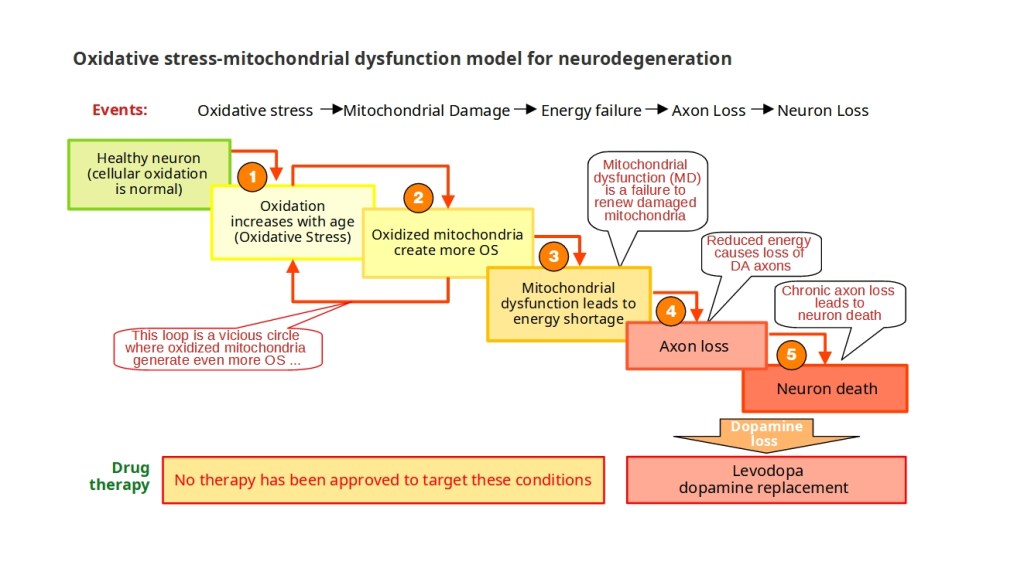
Addressing early-stage damage to dopamine-producing neurons
- To reduce and eventually eliminate the long-term stress and fatigue of dopaminergic neurons and alleviate the resulting symptoms.
- To improve the energy-producing capacity of these neurons by renewing damaged mitochondria,
- To improve the redistribution of dopamine to those parts of the brain that are suffering dopamine shortage,
- To enable dopamine neurons to repair damage by regrowing the axon arborescence,
- To prevent further damage to the more distant brain regions.
The first 3 changes involve reactions and operations inside cells. They include neutralizing oxidative stress (occurs in seconds) and restoring mitochondrial function (takes days). These changes could improve the quality of life of people with Parkinson’s in the short term.
The fourth goal involves repairing and regrowing cell parts, which may take longer than our experiments.
The fifth goal may only help prevent problems, with no noticeable effects during our experiments.
Maximizing the potential of Broccoli Seed Tea
Developing a reliable source of sulforaphane is a significant step.
After devoting more than four years to validating the impact of the Keap1/Nrf2/ARE pathway on Parkinson’s disease and engaging in extensive laboratory research to develop a standardized broccoli seed tea (BS1312) for activating the Nrf2 pathway, this research is now reaching its culmination.
The Keap1/Nrf2/ARE pathway was discarded by the pharmaceutical industry over a decade ago, not due to doubts about its potential effectiveness, but rather because its profitability could not be guaranteed. Projects based on natural molecules are often deemed unprofitable by commercial drug companies, regardless of any potential medical benefit for patients, as plant-based molecules cannot be protected by strong patents. Nevertheless, research by prominent scientists provides compelling evidence that the activation of the Keap1/Nrf2/ARE pathway could serve as a disease-modifying therapy for Parkinson’s disease patients. This theory was tested over a 30-month period using an extract of broccoli seeds containing sulforaphane, the most potent natural activator of the transcription factor Nrf2. Throughout this time, research into the biological and chemical processes involved in the conversion of glucoraphanin to sulforaphane resulted in progressive enhancements in the quality of the broccoli seed tea, leading to the development of BS1312.
The second phase, initiated in October 2022, involved conducting a pilot study to assess the effects of BS1312 on Urinary Urgency in Parkinson’s disease. Alongside this, other symptoms that significantly affect quality of life were closely monitored. The initial findings indicate the notable effectiveness of BS1312 in simultaneously alleviating a broad spectrum of non-motor symptoms associated with Parkinson’s disease. We encourage those passionate about Parkinson’s disease to contribute financial support to this important initiative.
We use only high-quality seeds from a unique source in our research.
The seeds of broccoli (Brassica oleracea var. italica) are known to contain glucoraphanin, the precursor of sulforaphane. Numerous broccoli varieties have been developed through crossbreeding with other brassica species, aimed at improving yield or resistance to pests. Consequently, the glucoraphanin content of broccoli seeds varies depending on the variety, though the actual content is often unknown. It is worth noting that certain special broccoli varieties, particularly those intended for sprouting, do not belong to the Brassica oleracea var. italica species, and their seeds may contain no glucoraphanin at all.
To address this issue, we have acquired a supply of broccoli seeds containing a high and measured glucoraphanin content for our research purposes. These seeds are not intended for commercial sale and are not accessible to the general public. Nonetheless, certain commercially-available broccoli seeds can be utilized to produce high-quality Broccoli Seed Tea.
The preparation of high-quality Broccoli Seed Tea
Broccoli Seed Tea is an excellent way to extract fully bioavailable active sulforaphane, although the process involves complex biological and chemical reactions.

To create sulforaphane, we need to extract glucoraphanin using hot water, then add an enzyme called myrosinase to break it down and release the glucose molecule. It’s crucial to control the temperature throughout the process.
The hydrolysis reaction produces an unstable intermediate molecule, which subsequently undergoes rearrangement to yield either sulforaphane or a nitrile, a biologically inactive molecule. Attaining a high yield of sulforaphane in the final reaction necessitates adherence to various parameters. Our research has culminated in the identification of optimal conditions for consistently producing high-quality broccoli seed tea. These conditions have been integrated into the BST Protocol.
.
 The Patient Researcher
Leave a comment