
Albert F Wright PhD
MyParkinsons officially came into my life in 2018, yet, its, debilitating non-motor symptoms had been wreaking havoc for many years, bringing overwhelming fatigue, daytime drowsiness, restless sleep with vivid dreams, confusion, and humiliating urinary urgency.
While I was still seated in the office of my “first” neurologist, trying to take in the full weight of the diagnosis, I was unequivocally informed that the causes of Parkinson’s were “unknown.” As a research scientist, aware that it can take decades for some research ideas to become widely accepted and trickle down to those practicing the art, I decided to check out this apparent knowledge gap. My journey to understand MyParkinsons began right there. After 5 years of research, I now describe MyParkinsons in a different way to the Parkinson’s disease that I now see described in research articles. I’m not saying that MyParkinsons is different to the Parkinson’s disease of other peole that I know. In fact it seems to be quite similar. But, because I own MyParkinsons, I can choose to describe it differently without upsetting anyone.
MyParkinson’s is about chemistry …
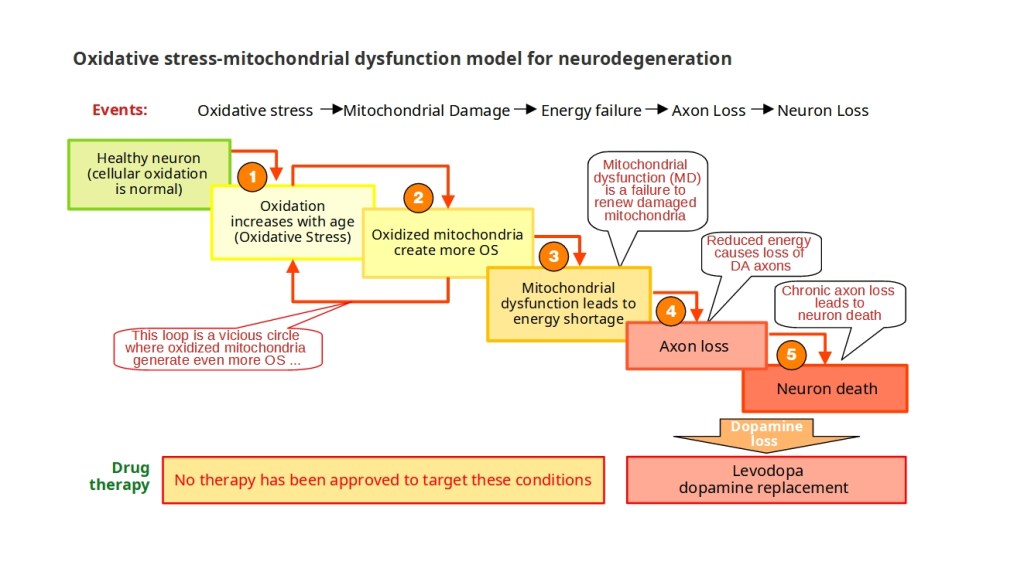
What I discovered was profoundly enlightening to me at the time. Although there may be several different causes of Parkinsons, a combination of oxidative stress and mitochondrial dysfunction (working together) in neurons would appear to be the main factor driving the progression of Parkinsons, regardless of the initial cause.
This information is of utmost importance, given the vital role mitochondria play in providing energy to all cells, particularly to neurons, which are major energy consumers. “Oxidative stress” (OS) arises when biological systems suffer chronic oxidation by “Reactive Oxygen Species.” The term ROS fails to convey the extreme agressivity of these highly-unstable free-radical versions of oxygen atoms or molecules which oxidize anything in their immediate vicinity at lightning speed. Many medical practitioners may be unfamiliar with these ultra-high-speed chemical reactions, whereas it falls well within the realm of expertise for a chemist like myself.
… in mitochondria
Almost all reactive oxygen species (ROS) are produced within mitochondria as a by-product of their primary activity: generating energy from glucose and oxygen. These ROS react instantly and indiscriminately by stealing an electron from whatever is in their immediate vicinity, often targeting the lipid membranes and the DNA of the host mitochondria. This exacerbates the situation, as the impaired mitochondria then generate even more ROS. Mitochondria and OS are tied in an inseparable vicious circle.
… in neurons
According to this hypothesis, one of the key factors to halting the progression of Parkinson’s disease might be summarized as maintaining the health of mitochondria in neurons (but not only).
A protein called Nrf2 …
When mitochondria in neurons malfunction, the more distant axons suffer catastrophic energy deprivation, leading to the partial loss of the dopamine neuron network in the affected regions, specifically the striatum. In individuals with healthy neuronal function, the signaling protein Nrf2 (nuclear factor erythroid-2-related factor 2) plays a crucial role in managing oxidative stress and mitochondrial function. It accomplishes this by activating the expression of numerous genes responsible for releasing antioxidant molecules and enzymes that migrate and reside inside mitochondria, forming a protective barrier to the living cells. However, as individuals age, the activity of Nrf2 decreases, allowing oxidative stress to escalate. This leaves certain types of neurons, particularly those producing dopamine, exceptionally vulnerable to damage.
… in Astrocytes
Astrocytes play a crucial role in the brain, facilitating a wide range of transport and housekeeping functions by forming astrocyte-controlled bridges that link axons of neurons to the cerebral blood supply. Notably, there is minimal Nrf2 activity in neurons compared to its high activity in astrocytes, leaving the mitochondria in neurons dependent on the protective role of Nrf2 in astrocytes. Therefore, the level of activity of Nrf2 in astrocytes would appear to be a key factor that regulates the progression of Parkinson’s disease.

… with a little help from Sulforaphane
One highly effective approach to activating Nrf2 entails the use of a isothiocyanate known as sulforaphane. Sulforaphane is a potent stimulator of Nrf2 activity because it inhibits another protein (called Keap1) which captures and degrades Nrf2. Inhibiting Keap1 frees up much more Nrf2 to produce more antioxidants. Sulforaphane and has demonstrated its ability to reduce oxidative stress while enhancing mitochondrial function.
A very cost-effective and readily available way of obtaining sulforaphane is through the hydrolysis of glucoraphanin, a sulfur-rich compound of glucose that is present in certain varieties of broccoli seed. The process of converting glucoraphanin to sulforaphane necessitates the use of an enzyme called myrosinase, which cleaves off the glucose molecule. The resulting compound then undergoes a series of chemical rearrangements. The yield of sulforaphane is substantially dependent on the quality of the seeds and the reaction conditions. Back in 2019, when I first came across this, the conditions that deliver an optimum yeild of sulforaphane had not been published.

The players in MyParkinsons
Oxidative stress, mitochondria, astrocytes, neurons, dopamine, Nrf2, Keap1, broccoli seeds and sulforaphane. These were the players that always had something to say about MyParkinsons. The next step would be to bring them together
Medical disclaimer. Information on this site is not intended or implied to be medical advice of any kind. All content, including text, graphics, videos, images and information, contained on or available through this website is for general information purposes only. The author is not a medical professional and does not give medical advice or opinion to or concerning any individual or group. The author does not recommend, endorse or make any claims about the efficacy, accuracy or suitability of any specific tests, techniques, procedures, treatments, opinions, or other information on this website. The author is neither responsible nor liable for any interpretation of information obtained through this website, nor for any damages arising therefrom. Information presented on this website has not been confirmed or validated by any third party and is subject to change without notice. Readers are strongly encouraged to confirm the information contained herein with that from other sources. Never disregard professional medical advice or delay seeking medical treatment because of something you have read on or accessed through this website.
 The Patient Researcher