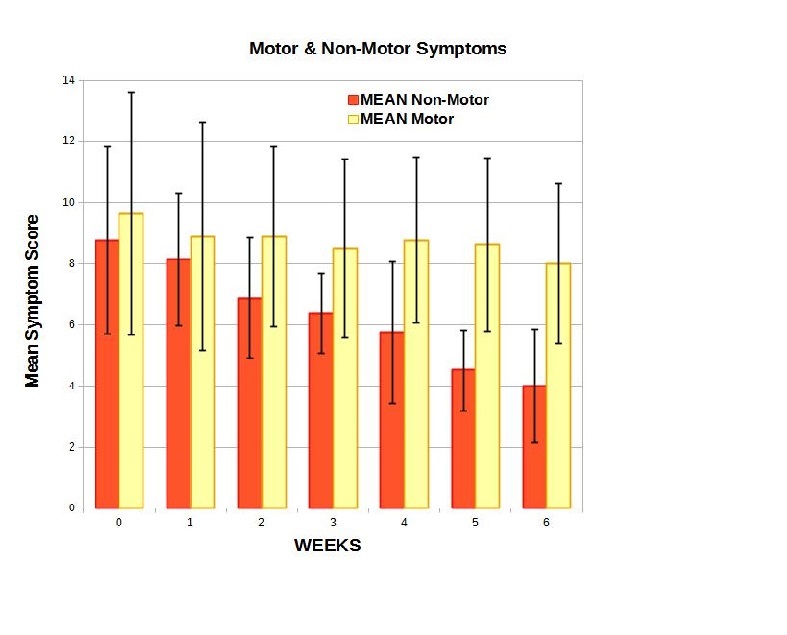
Eight coordinated studies, conducted by people with Parkinson’s, found that non-motor symptoms were significantly reduced by broccoli seed tea, while motor symptoms showed no change over the 6-week program.
To access the full report and its interpretation, please download the article “Broccoli Tea Experiment Results and Interpretation” from the “Documents” page.
These findings suggest that the mechanisms underlying the generation and mitigation of non-motor symptoms differ from those related to motor symptoms. They are entirely consistent with the hypothesis that the initial stage of Parkinson’s disease involves oxidative stress-induced damage to mitochondria, consequently resulting in an energy deficit in dopaminergic neurons. This ongoing condition progressively contributes to a reduction in their dopamine production, ultimately leading to motor symptoms of the disease, such as slowness, stiffness, and tremor.
For more information on the scientific rationale behind this experiment, please read “Resetting the Redox Balance to fight Parkinson’s disease.” You can find the article at this link.
The Protocol
Experiments and observations by the author led to the development of a protocol for preparing and dosing Brassica seed extracts, along with a checklist for tracking symptom progression over time. This protocol was shared with a group of Parkinson’s disease patients in October 2020, some of whom chose to participate in a self-experimentation program by making their own broccoli tea and sharing their data for analysis.
Making sulforaphane from Brassica seeds
To achieve a substantial yield of sulforaphane from broccoli seeds or sprouts, it is crucial to consider the fundamental chemistry of the phytochemicals and enzymes present. These seeds or sprouts encompass two distinct substances: glucoraphanin, which serves as the precursor of sulforaphane, and myrosinase, an enzyme facilitating the conversion of glucoraphanin to sulforaphane. The efficient functioning of the enzyme is essential for obtaining a high yield of sulforaphane. However, the conditions in the gastrointestinal tract, including temperature and pH, contribute to the low bioavailability of sulforaphane. Elevated temperatures can lead to the destruction of the myrosinase enzyme, thereby impeding sulforaphane production. Consequently, cooked broccoli is found to contain minimal amounts of sulforaphane. Alternatively, white mustard seeds contain a more effective type of myrosinase compared to that in broccoli seeds and can be used as a substitute. Through optimized hydrolysis conditions, a cloudy suspension is produced, which can be filtered through a fine-mesh tea strainer to eliminate inactive particulate matter. This resulting suspension contains highly bioavailable sulforaphane, which plays a crucial role in modulating Keap1 and enabling Nrf2 to carry out its function.
Results
The outcome of this experiment proved to be remarkable. It unequivocally demonstrated that a distinct set of symptoms, known as non-motor symptoms, exhibited a robust response to this treatment within a mere few weeks, while the motor symptoms showed virtually no change over this brief timeframe.
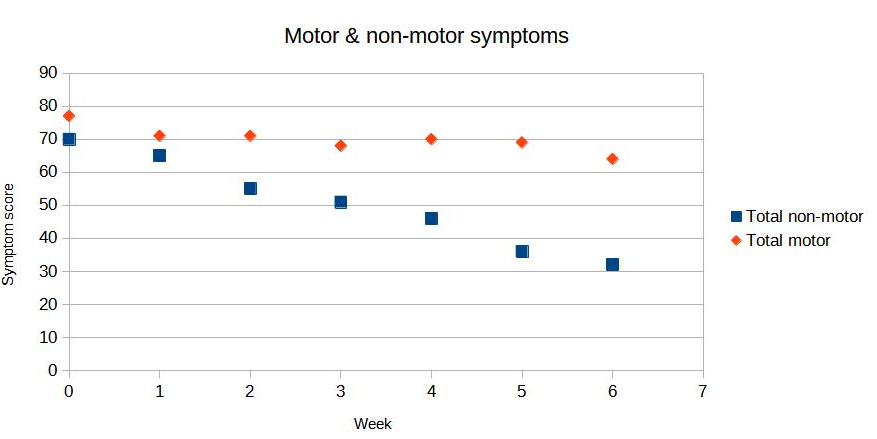
Non-motor symptoms were significantly reduced by the consumption of broccoli seed tea, while motor symptoms remained unaffected.
These findings are both promising and enlightening. Promising, as they offer the initial proof that activating Nrf2 has an immediate and significant influence on a specific set of Parkinson’s disease symptoms. Enlightening, as the differentiation between non-motor and motor symptoms offers insights into the underlying mechanisms when Nrf2 affects the neuronal health. This outcome was accomplished by Parkinson’s patients seeking a deeper understanding of the disease.
- A broccoli tea, containing sulforaphane, effectively alleviates a specific set of Parkinson’s disease symptoms.
- There was a clear distinction in the response of non-motor compared to motor symptoms. This suggests the involvement of at least two distinct mechanisms in the development and/or resolution of Parkinson’s disease symptoms.
What further insights can we derive from the findings of this patient-driven investigation?
The three symptoms that showed the most significant and progressive response to the treatment were “fatigue, sleep quality, and lack of motivation.” These symptoms are closely linked to energy production. This suggests that the initial direct effect of upregulating Nrf2 is to enhance energy production in neurons, likely by reducing ROS damage to mitochondria. If this is the case, it could potentially disrupt the cycle in which mitochondrial damage, once established, becomes self-sustaining due to ROS damage creating more ROS, leading to further mitochondrial damage, and so on. In severe cases, this cycle can spiral out of control. It can be inferred from this that oxidative stress is likely to be the predominant mechanism in the development of the process that gives rise to these non-motor symptoms. If confirmed, this mechanistic pathway should be the primary focus of investigation in any therapeutic approach to combat Parkinson’s disease.
Urinary incontinence and nocturnal urinary frequency showed significant improvement as well. These symptoms profoundly affect the quality of life of individuals living with Parkinson’s disease.
3 responses to “The broccoli seed tea experiment”
-
Thank you so much for your incredible work Albert!Where can we found the r
recipe for your Broccoli seed Tea? -
Looking to assist spouse with his nonmotor symptoms if possible with recommendations. Tried so many different things with no avail. Please help.
-
Thank you Albert for your work! I just upgraded to paid. I was hoping for the broccoli seed tea recipe, sooner vs later! Looking forward to more of your research, analysis and discussion.
Victoria


 The Patient Researcher
Leave a reply to Riad Cancel reply